









Mexico's environment secretary lauds Honghu water purification plant


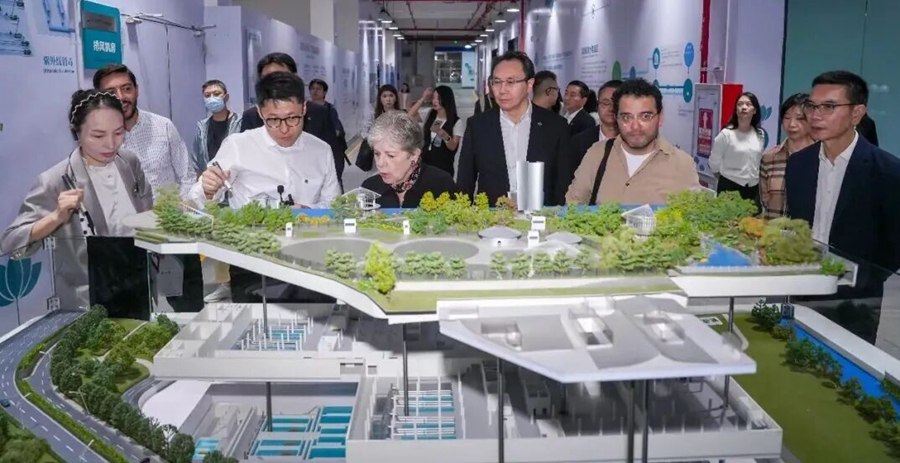
A Mexican delegation, led by Mexico's Secretary of Environment and Natural Resources Alicia Barcena Ibarra, visited the Honghu Water Purification Plant in Luohu District on November 15 during a tour of Shenzhen ahead of the 2026 APEC Economic Leaders' Meeting. File photo
A Mexican delegation, led by Mexico's Secretary of Environment and Natural Resources Alicia Barcena Ibarra, visited the Honghu Water Purification Plant in Luohu District on November 15 during a tour of Shenzhen ahead of the 2026 APEC Economic Leaders' Meeting.
The Honghu water purification plant is designed to do more than treat wastewater. Built beneath the Honghu Park, the facility brings together water treatment, environmental protection and recreational space.
“You would never imagine that there is a sewage treatment plant beneath our feet — it is very impressive,” Bárcena said.
She praised the way the site combines environmental management with public well-being, noting that visitors can enjoy the park above without encountering odors or signs of pollution.
The Mexican delegation's itinerary also included the Dasha River and the Shenzhen Talent Park.
“My visit to the Dasha River and the Honghu Water Purification Plant was very interesting,” Bárcena said. “It shows how China combines the environment with people’s well-being and has built such a beautiful place."
She added that visitors can enjoy the Honghu Park above the plant without encountering odors or any sense of pollution. Having visited China many times, Bárcena said this was her first trip to Shenzhen and Mexico could learn from China’s green development experience under the APEC framework.
The Honghu plant has a two-level underground layout. The treatment facilities are on the second basement level, while the first basement level houses production and operations areas, along with the Qinglian Gallery and Shuihe Hall, which offer public education. Above ground, the Furong Park provides a green space for residents.
The plant’s first phase is designed to treat 50,000 cubic meters of wastewater per day. Its planned long-term capacity is 100,000 cubic meters per day. The facility uses an AAO+MBR treatment process, and its main treated-water quality indicators meet the quasi-Class IV standard under China’s Environmental Quality Standards for Surface Water, except for total nitrogen.
Treated water is reused in two ways: some supplies the Honghu Park’s water features, while the remainder is discharged into the nearby Buji River for ecological replenishment. In this way, water flowing through the park’s landscape may have been treated at the facility below.
Odor control is another feature of the plant’s design. Enclosed collection and treatment systems combine double-layer coverage, pressurized containment and biological deodorization throughout the process. The plant says emissions at its boundary meet China’s national Level I standard, with no odor detectable in the park above.
The Honghu plant is the first underground water purification plant in China to achieve full 5G signal coverage. The network connects staff, equipment and operational systems, supporting coordinated operations and more efficient use of resources.
An integrated digital-twin platform supports intelligent process control, inspections and predictive equipment maintenance. Together, these systems enable automated production, digital operations and data-informed decision-making.
 粤公网安备 44030302000492号
